Your satisfaction is our relentless pursuit! We warmly welcome you to come and discuss business; we will serve you wholeheartedly.
Your satisfaction is our relentless pursuit! We warmly welcome you to come and discuss business; we will serve you wholeheartedly.
 author
The calculation of septic tank usage is related to the following factors: the total number of people (N) in the septic tank design, the daily sewage quota (q) per person, the sewage retention time (t) in the septic tank, the percentage of people actually using sanitary appliances compared to the total number of people in the design, the sludge moisture content (b=95%), the concentrated sludge moisture content (c=90%), the sludge reduction coefficient (k=0.8) during the decomposition period, the septic tank cleaning cycle (T) determined by design for 90 days, 180 days, and 360 days, the volume coefficient of the digested sludge after cleaning (20%), and the sludge volume per person per day (a=0.7L/person.d) for combined sewer systems and (a=0.4L/person.d) for separate sewer systems.
The parameters are determined according to the standard GB50015-2003, pages 71-72.
The volume (W) of a septic tank consists of the sewage volume (W1) and the sludge volume (W2).
W1=N*q*t*α/(24*1000)
W2=1.2*(a*N*α*T(1-b)*k)/((1-c)*1000)
The exact number of sanitary fixtures cannot be accurately calculated for septic tanks; the total number of people must be determined first.
The guidelines for rural toilet renovation provide suggestions for your reference.
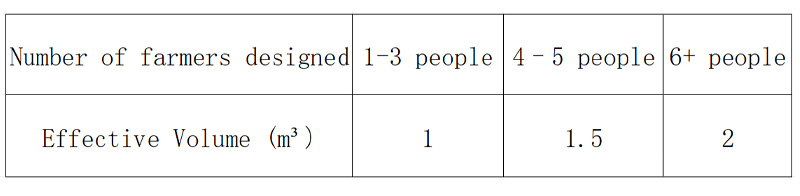
Reference values for the volume of three-compartment septic tanks in rural toilet renovation